I've spent two decades inside large financial institutions watching how technical talent actually develops, and a pattern has emerged over the past two years that I find genuinely concerning. AI tooling has become good enough to absorb much of the work that entry-level consultants and engineers used to do. The routine code, the first-pass analysis, the documentation, the test scaffolding. This looks like pure efficiency on a quarterly budget review, and in the short term it is.
The problem sits ten years downstream.
Entry-level roles were never only about output. They were the training ground where the next generation of senior talent got built. When you remove the work, you remove the apprenticeship that came bundled with it. The industry is currently making a trade it hasn't fully priced, and I think senior executives in finance need to look at this now, while the decision is still theirs to shape.
What Junior Work Actually Produced
Consider what a first-year engineer on a trading platform team actually did. They wrote the boilerplate, yes. They also sat in the design reviews where that boilerplate got torn apart. They shipped a component, watched it fail in UAT, and learned why the architecture mattered. They absorbed the unwritten rules of how regulated systems get built, which constraints are real, and which are inherited assumptions nobody has questioned in a decade.
That learning was never the deliverable. It was a byproduct of doing low-stakes work inside high-stakes environments, with senior people close enough to correct course.
The output was the excuse. The judgment was the product.
AI now produces the output faster and often cleaner. The judgment, however, doesn't transfer with it. A model generates the code, and no human being accumulated the scar tissue of writing it wrong first. Across the engagements I've observed, the institutions adopting AI tooling most aggressively are also the ones quietly closing the door through which their senior people originally entered.
The Data Already Pointed at People, Not Technology
Here's the fact chain that shapes my view. Banks spent $650 billion on technology last year, and analysts at McKinsey concluded they have little to show for it. Industry analysis suggests roughly 70% of projects in financial services technology fail, with migration costs frequently exceeding initial budgets by 300%. Research on AI initiatives specifically found that the projects that fail are rarely beaten by the technology itself. Leadership creates the conditions for success or failure.
Fact one: the spend is enormous. Fact two: the failure rate is persistent. Fact three: the technology usually works. Therefore the constraint is human judgment, and it has been for a long time.
Now layer AI onto that picture. If judgment was already the scarce resource before AI arrived, and AI removes the mechanism by which judgment gets manufactured, then the scarcity gets worse over time, quietly, while every quarterly report shows improved productivity.
💡 The efficiency gain is real. The talent debt accruing underneath it is also real, and it compounds silently until it comes due.
Why Seniority-Biased Hiring Was Already the Right Model
I built RocketFin on a specific thesis: small teams of senior specialists outperform large groups of generalists, consistently and measurably. The research supports this. QSM's analysis found that on large projects, large teams were four times more expensive than small teams and delivered three times as many defects. Brooks' Law has held for fifty years for a reason. Competence compounds faster than coordination overhead.
So I have every commercial incentive to celebrate an industry shift toward senior-heavy hiring. AI makes my model look prescient. Senior people paired with capable tooling deliver more than they ever did, and the case for padding teams with junior headcount weakens every quarter.
And yet I think the honest version of this argument requires acknowledging what the model consumes.
Senior specialists are a harvested resource. Every one of them was, at some point, a junior engineer who got twenty years of reps inside systems that mattered. My firm, and every firm structured like mine, draws down a stock of expertise that the traditional entry-level pipeline built. If the industry as a whole stops replenishing that stock, the seniority-biased model eventually runs out of the thing it's biased toward.
The business case for hiring senior people was never anti-junior. It was anti-generalist, anti-bloat, and anti-theatre. Those are different objections entirely.
The Shortfall Nobody Is Modeling
Banking technology is getting more complex, at pace. McKinsey found the average number of applications per billion dollars of revenue in banking IT jumped 68% between 2013 and 2022. Legacy systems, regulatory constraints, and departmental silos already block progress at half the institutions surveyed. Navigating that complexity requires people who understand implementation, regulation, and business consequence simultaneously.
Those people take fifteen to twenty years to develop.
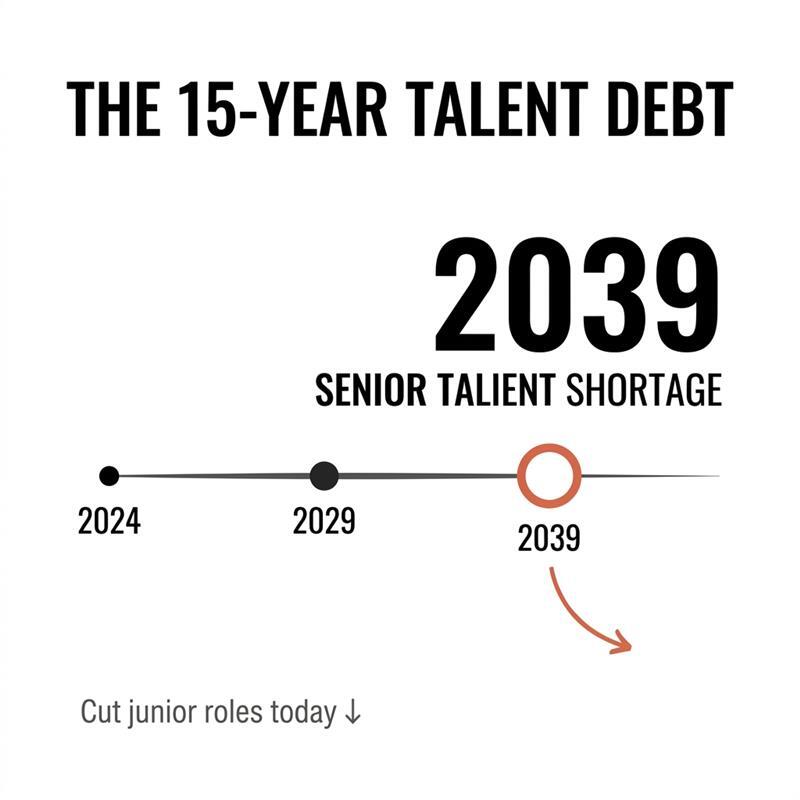
Run the projection forward. If entry-level hiring in technology and consulting contracts sharply from 2024 onward, the senior cohort of 2039 is being decided right now, in this year's graduate intake numbers. The institutions cutting those programs today will be bidding against each other for a diminished pool of genuine seniors in a decade, and the price of real expertise will reflect that scarcity. Margin compression on talent, arriving on a fifteen-year delay.
⚠️ The shortfall won't announce itself. It will surface as project failures attributed to everything except the hiring decisions made a decade earlier.
What I'd Actually Recommend
I used to believe the entry-level pipeline would sort itself out through market pressure. I've revised that view. Markets correct on visible signals, and a talent gap with a fifteen-year lag is close to invisible until it's structural. So here is what the evidence suggests to senior leaders in a position to act.
First, separate the output question from the development question. AI legitimately replaces junior output. It replaces none of the junior development. If you keep entry-level roles, redesign them explicitly as apprenticeships: fewer hires, deliberately placed inside senior teams, doing supervised work on real systems rather than disposable tasks.
Second, treat senior mentorship as a funded activity.The old model buried training costs inside billable junior hours. That subsidy is gone. If you want the training to happen, it now needs its own line item, and pretending otherwise means it simply won't happen.
Third, bias your hiring toward seniority for delivery, and toward potential for development, and keep those two tracks honest with each other. The small senior team remains the right delivery structure. The evidence on defect rates and cost supports it. It works best when it also functions as the room where the next generation of seniors gets made.
The institutions that get this right will hold an insane advantage in ten years, because they'll own the one asset that can't be procured on demand: people with genuine, tested judgment in high-stakes systems. Everyone else will be renting that judgment at whatever price the shortage sets.
So the question I'd put to any executive reading this: when you look at your current graduate intake and your senior bench, whose 2039 delivery capability are you actually funding?
https://www.americanbanker.com/news/enough-already-analysts-question-banks-650-billion-tech-spend