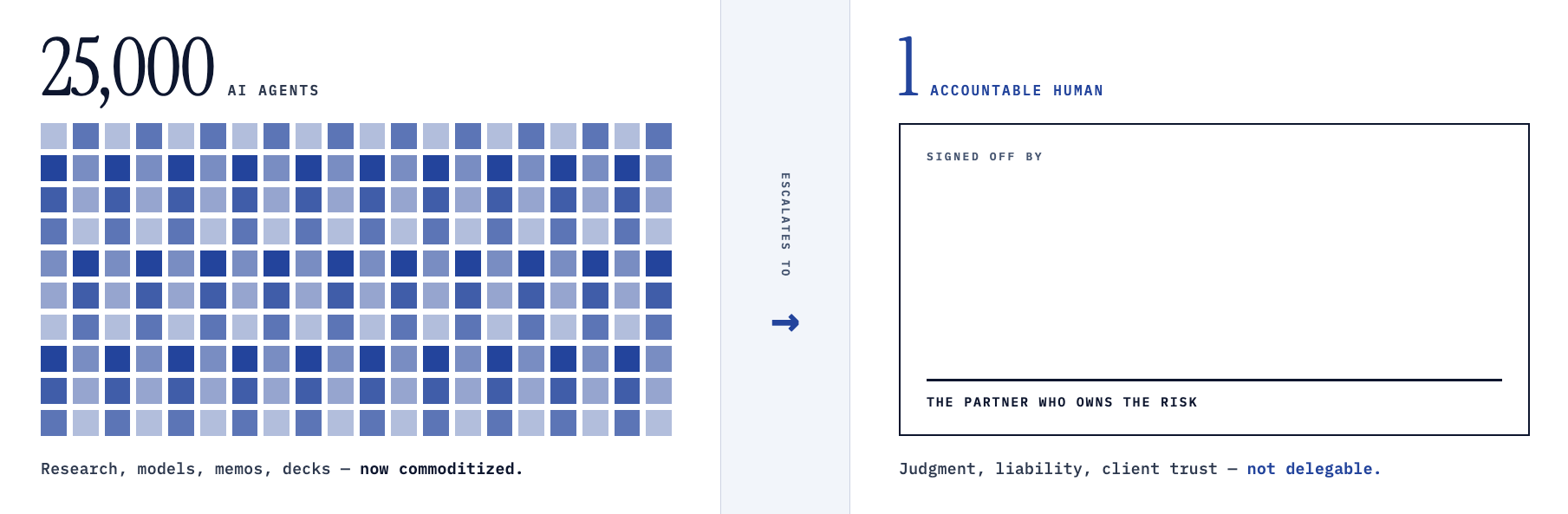
McKinsey now operates roughly 25,000 AI agents alongside around 40,000 human consultants. On the surface, the story reads as automation at scale, a firm quietly replacing analyst hours with software. Espen Skogen, Chief Executive of RocketFin, reads it differently. He sees a deliberate architectural decision, and buried inside that decision sits an uncomfortable admission about what professional services actually sell.
The admission is this. The AI itself carries almost no differentiation.
The models McKinsey accesses are, in practical terms, the same models their competitors access. They're also the same models their clients access. If McKinsey can leverage AI to generate insight, so can the bank that hired them. So can the regulator watching that bank. The technology has become table stakes, available to anyone with a procurement budget and an API key.
Which raises the question every professional services leader should be sitting with right now. If the machine produces the analysis, what exactly are clients paying for?
The Value Was Never the Deck
Skogen has spent two decades inside major financial institutions, most recently Royal Bank of Canada, watching how decisions actually get made at the top of large organizations. His observation, formed across years of trading platform and risk system delivery, is that the analysis rarely drives the decision. The person delivering the analysis does.
A board doesn't act on a finding because the finding is correct. Boards see correct findings ignored constantly. A board acts when someone with standing walks into the room, attaches their name to the conclusion, and delivers the bad news directly. That's the product. The insight is the raw material. The accountability is what gets invoiced.
This is what McKinsey understands about its own model, and it explains the 40,000 humans. The agents generate. The consultants underwrite. When a McKinsey partner tells a board their core platform strategy will fail, the value isn't in the sentence. It's in the fact that a specific person with a specific reputation said it, and that person will still be in the room when the consequences arrive.
You can subscribe to the same models McKinsey uses. You can't subscribe to someone willing to stake their name on what the models produce.
Why This Matters More in Finance Than Anywhere Else
Skogen's client base, senior executives at large financial institutions, operates in an environment where the cost of a wrong technology decision is measured in regulatory exposure and public failure. The data here is sobering. Research indicates that around 70% of financial services technology projects fail, and for financial institutions those failures carry regulatory fines averaging $250 to $500 million per incident, with migration costs that often exceed initial budgets by 300%.
The institutional memory of these failures runs deep. When Royal Bank of Scotland's 2012 software update went wrong, six million customers lost access to their accounts for weeks, and the bank paid a £42 million fine. Parliamentary evidence shows the scar tissue this leaves behind. Some 43% of financial institutions report difficulty securing boardroom sponsorship for modernization, and 36% say the risk and failure rate of core replacement programs prevents them from attempting such work at all.
Read those numbers together and a pattern emerges. Boards in finance are frozen by the memory of failed delivery.
An AI agent can produce a flawless analysis recommending core replacement. It changes nothing about that freeze. What unfreezes a board is a person they trust, someone who has built these systems, who understands the regulatory constraint and the technical architecture in the same conversation, saying the risk is manageable and putting their reputation behind that claim.
⚠️ The pattern Skogen identifies here is worth stating plainly. AI compresses the cost of insight toward zero, which means insight stops being the scarce asset. Accountability becomes the scarce asset, and its price rises accordingly.
The Question of the Name on the Door
Skogen frames the challenge to his peers in professional services as a diagnostic exercise. Every firm now needs to identify its equivalent of the McKinsey partner's signature, the specific human asset that survives when the analytical layer commoditizes.
For some firms, honestly examined, that asset doesn't exist. Their entire margin depended on labor arbitrage, on billing junior analysts to assemble information that clients couldn't assemble themselves. AI removes that arbitrage. The margin compresses, and there's nothing underneath.
For firms built on earned authority, the picture looks different. Skogen's own model at RocketFin illustrates the alternative structure. The firm deploys small teams of senior specialists for high stakes technology delivery in global finance, and the research supports the composition. Analysis of 491 software projects found that teams of three to seven people deliver the best performance, and smaller teams complete projects with 39% higher productivity than larger ones.
As Fred Brooks observed in The Mythical Man Month, "Adding human resources to a late software project makes it later."
The relevance to the AI question is structural. A small senior team survives the commoditization of analysis because analysis was never what it sold. It sold judgment, delivery under regulatory constraint, and the willingness of named individuals to own outcomes. Those properties don't degrade when the client gets access to the same models. They arguably appreciate, because the flood of machine generated insight makes trusted human filtration more valuable.
💡 The practical test Skogen proposes: remove every deliverable your firm produces that a competent client could now generate internally with AI. Whatever remains is your actual business. If nothing remains, you've learned something important while there's still time to act on it.
What Boards Will Pay For Next
Skogen's view of the next phase in professional services follows a logical chain. Fact one, AI capability distributes evenly across firms and clients, so it confers no lasting edge to any of them. Fact two, high stakes decisions in regulated industries require a human to absorb accountability, because regulators, boards, and courts hold people responsible rather than models. Fact three, the supply of people with genuine cross-domain authority, the kind who can explain both the legal implications and the technical architecture because they've built both sides, remains extremely limited.
Therefore the market for AI generated insight trends toward zero margin, while the market for accountable senior judgment tightens. In economic terms, the analytical layer depreciates while the trust layer appreciates.
McKinsey's 25,000 agents make sense inside this logic. The firm is deliberately commoditizing its own lower layers before someone else does, and concentrating its economics in the layer that can't be replicated by a competitor's API subscription. Whether the execution succeeds is a separate question. The architecture, Skogen would note, is sound.
For everyone else in professional services, the exercise is less comfortable. The AI transition doesn't threaten firms because machines got smart. It threatens them because it exposes which firms were selling accountability and which were selling assembled information at a markup. That exposure has been coming for a while. AI simply accelerated the timeline.
Your clients already have the models. What do they still need your name for?