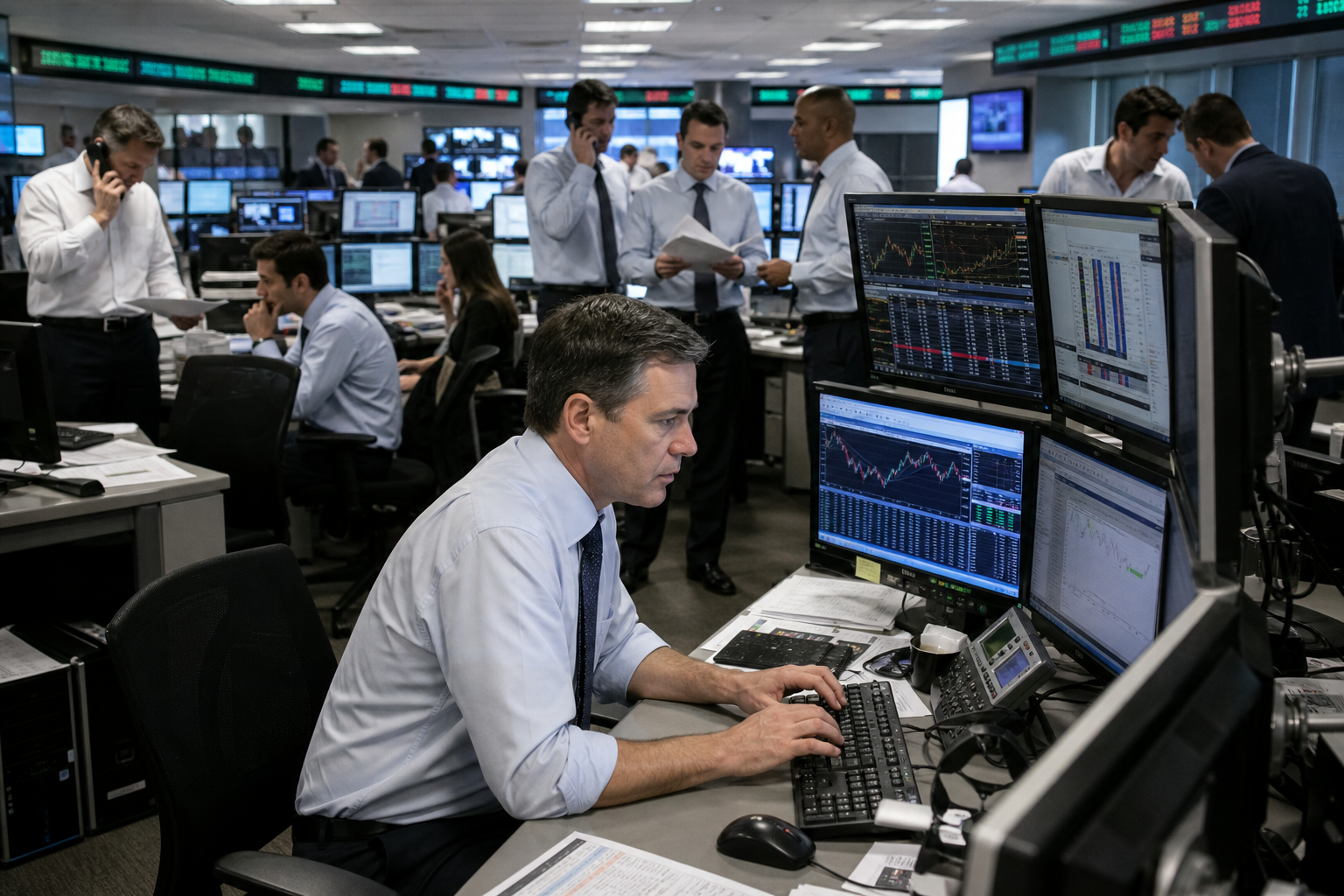
A fixed income desk of ten people can process a considerable amount of activity before anyone describes the operating model as a problem. Orders arrive, prices get sourced, trades get done, and the records eventually agree. The work gets finished because experienced people finish it, which is precisely what makes the underlying cost so difficult to observe. Nothing fails visibly. No platform goes down, no break reaches the top of the risk report, and no regulator writes a letter. The cost accumulates in the space between systems instead, in the minutes spent re-entering an order into a second interface, in the call that establishes which record is authoritative, and in the afternoon somebody loses reconstructing what happened on a trade from three weeks ago.
That space has a price. It simply doesn't arrive on an invoice.
Electronic execution has expanded far enough to make the point unavoidable. Around 60% of credit market participants now engage in electronic execution, and investment grade electronic trading in the United States moved from 20% in 2015 to 48% in 2025. Adoption on that scale changes what a workflow is asked to carry. More venues, more liquidity providers, more order types, and more evidence obligations all arrive through the same small team, and each addition lands on a process that was assembled for a narrower set of conditions.
The seam is where the cost lives
Order management and execution management were separated at a point when the two functions genuinely did different work. An order management system held intent, allocation, compliance constraints, and position. An execution system found liquidity and got the trade done. The separation described the market reasonably well when liquidity sat in fewer places and the record of a trade could be assembled at the end of the day without much argument.
Fixed income has moved. Liquidity fragments across dealers, venues, and providers, it appears episodically, and the price available depends on relationship, size, instrument, and the information a trader holds at the moment of execution. A workflow split across two or three systems now has to reassemble a picture that the market itself is actively pulling apart. The systems continue to operate. The user carries the burden of joining them together.
That burden shows up in patterns rather than incidents. Information gets re-entered across systems. Order status becomes difficult to reconcile when two records disagree about what has been filled. Liquidity information arrives without the context that would make it useful. Execution decisions become hard to review later because the reasoning lived in the head of the person who made them and the systems captured only the outcome. Exceptions require manual investigation across multiple workflows, and operational teams spend time correcting issues that the original process created.
None of these are failures. They are the running cost of a seam.
The tax compounds with volume
Fixed income volumes grew 44% year over year in 2025, and government bond volumes rose 76%. A workflow that absorbs a few minutes of friction per order behaves quite differently at those levels. Friction of this kind accrues rather than repeats, in the same way that a small financing cost carried against a growing balance produces an obligation that eventually determines what else the firm can afford to do.
The compounding is not only temporal. Each manual step is a point where timing, context, or evidence can be lost, and the probability that at least one of those points fails rises with the number of steps and the number of orders passing through them. A single data inconsistency is a nuisance. A single data inconsistency in a month where nobody can determine which system holds the authoritative record becomes a reporting problem, and reporting problems attract attention from people whose time is considerably more expensive than the trader's.
The pattern that emerges across firms of this size is fairly consistent. Capacity does not run out gradually. It holds, and then a period of elevated volume arrives and the desk discovers that its throughput ceiling was set by process rather than by people.
It rarely appears in the business case
Costs distributed across departments and across time have an unfortunate property. They are real, they are measurable in aggregate, and they are almost never attributed to the thing that causes them. The trader's lost hour gets recorded as trading. The operations analyst's exception chase gets recorded as operations. The compliance officer's reconstruction of a decision gets recorded as compliance. No line in the budget says seam.
This is why technology evaluations in this segment tend to be somewhat miscalibrated. The question asked is usually whether a platform connects to the required venues and supports the required instruments, which produces a feature comparison and a licensing discussion. The question that determines the outcome is whether the combined workflow gives the user better information at the moment the information matters, and whether the firm can evidence the decision afterwards without assembling it from three places.
A platform can satisfy an entire technical specification and still leave the operating model unchanged. The organisation acquires more capability, the users receive more screens, the project is declared complete because the documented requirements were delivered, and the people using the system still spend too much of the day managing the system.
The mid-sized firm carries it differently
Large institutions absorb this cost through headcount and dedicated teams. Firms running five to fifteen seats do not have that option, and they face the same regulatory requirements, the same best execution expectations, the same integration work, and the same fragmentation. The constraint is not ambition. It is that every hour spent on coordination is an hour not spent on the orders that actually require judgment, and a desk of that size has a very limited number of those hours.
There is a second constraint that gets less attention. The prevailing assumption in this market is that fixing the execution layer means replacing the order management system, which turns an operational improvement into a multi-year programme with migration risk attached. For a firm of this size that calculation almost never clears the hurdle, so the seam persists, not because anyone defends it, but because the only remedy on offer costs more than the problem appears to.
That assumption deserves more scrutiny than it usually receives. An execution layer that sits alongside the incumbent order management system rather than displacing it changes the arithmetic entirely, because the comparison is then between the running cost of the seam and the cost of closing it, rather than between the seam and a rebuild.
What a coherent record would change
The useful test is not how many connections a system holds. It is whether an order carries its intent, its context, its constraints, its execution, and its evidence as one record, and whether anyone reviewing that record six months later can tell what was decided and why.
Systems that meet that test reduce handoffs without attempting to remove the judgment that complex orders require. They preserve the history rather than reassembling it. They make automation available for the orders that genuinely do not need a person, which is what gives experienced traders their day back for the ones that do.
A question worth sitting with in the meantime. If somebody asked your desk to produce the full record of a single order, from intent through to settlement, how many systems would that take, and how long?