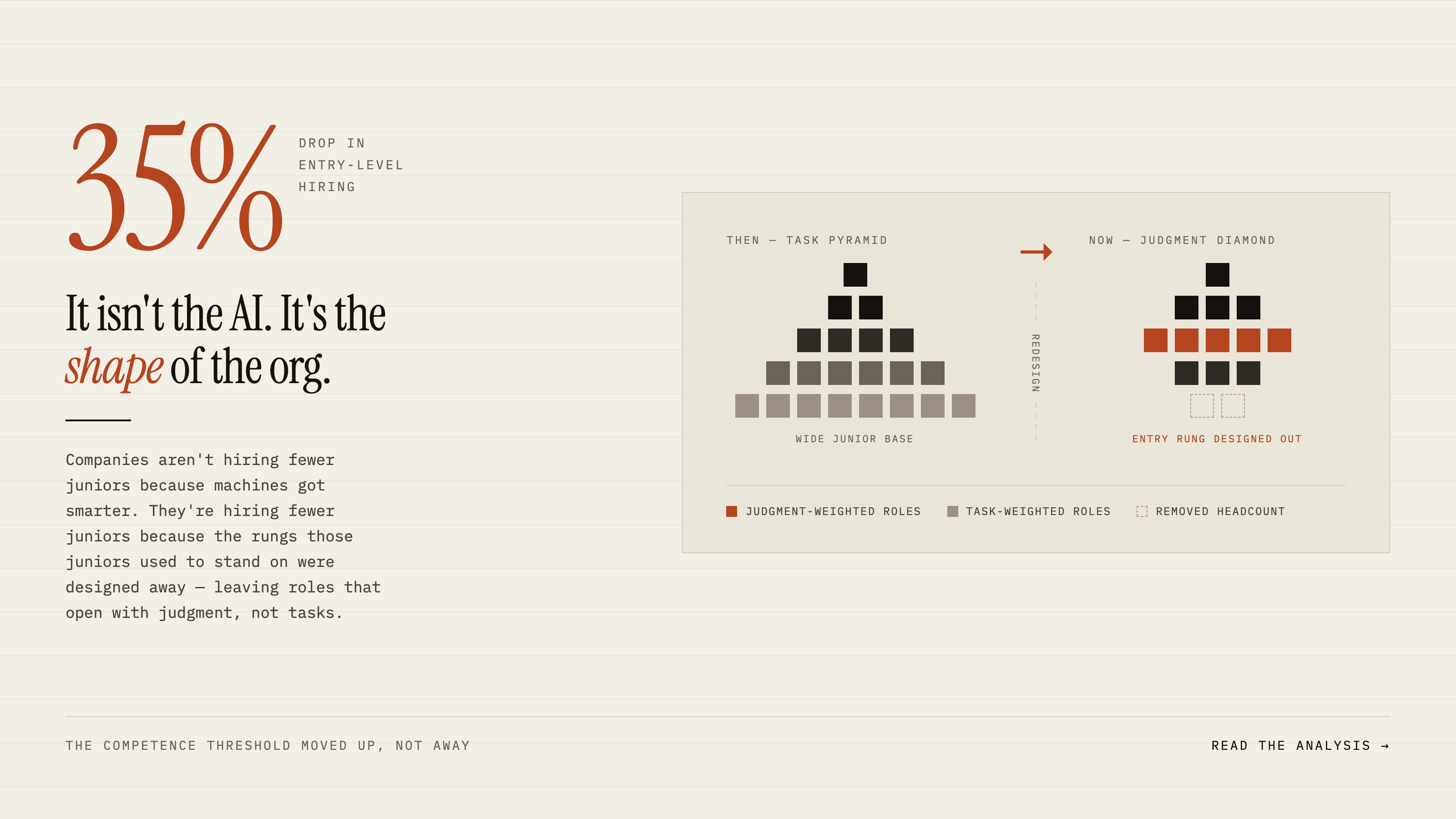
Entry-level hiring in professional services and technology has fallen by roughly a third. The instinctive explanation writes itself: AI arrived, AI absorbed the junior work, and the junior jobs disappeared. Espen Skogen, chief executive of RocketFin, has spent two decades inside large financial institutions watching how delivery decisions actually get made, and he finds that explanation somewhat suboptimal. The correlation between AI adoption and the hiring drop is real. The causation is far less clear than the headlines suggest.
His reading of the pattern is more uncomfortable than the AI story. Firms had structural reasons to cut these roles long before large language models became boardroom vocabulary. AI gave them a socially acceptable moment to act on conclusions they had already reached.
The jobs didn't vanish. The specification for them was rewritten.
Correlation Arrived With a Convenient Alibi
The timeline invites a causal reading. AI tooling scaled through 2023 and 2024, and entry-level requisitions collapsed in the same window. But Skogen's pattern across engagements at tier-one institutions points somewhere else. The economics of large junior cohorts were already broken.
The research on team composition has said this for years. Studies compiled by QSM found that on large projects, large teams were four times more expensiveand delivered three times as many defects as small teams. A team of fifteen people carries 105 lines of communication. Every junior hire added to a delivery organization adds coordination cost before adding output.
💡 The pattern worth noticing: firms tolerated that cost when clients paid for headcount. The moment clients started paying for outcomes, the pyramid stopped making financial sense.
So when executives attribute the cuts to AI, Skogen hears something closer to a market correction being rebranded as a technology event. AI is the stated cause. The unstated cause is that the leverage model of stacking generalists under a handful of seniors was accruing debt for years, and someone finally read the balance sheet.
The Work Changed Shape Before It Changed Size
Here is where the investigation gets interesting. Look at what firms like McKinsey are actually doing rather than what commentary says they're doing. These moves read as deliberate architecture. They restructure how work flows through the organization, redesign what a first-year professional is expected to produce, and rebuild the ratio of judgment to production in every role.
That is a design specification, and design specifications reveal intent.
The entry-level role of 2019 existed to perform pattern-matching at scale. Document review, data assembly, first-draft production, slide formatting. The evidence from delivery environments shows this category of work compressing dramatically. What remains at the entry level now requires synthesis, client judgment, and domain context from day one.
Skogen's own firm was built on this exact thesis before AI made it fashionable. RocketFin staffs small, senior teams for high-stakes financial technology delivery because the data on team composition demanded it. Research analyzing 65 million papers, patents, and software projects found that smaller teams more commonly introduce the ideas that disrupt fields, while large teams develop existing ones. Firms redesigning around lean senior cores are following evidence that predates every current AI model.
The problem is never the technology. If you think it's a technology problem, you've misdiagnosed it. It's a people problem wearing a technical mask.
That principle, central to how Skogen diagnoses delivery failures, applies directly here. The hiring drop looks like a technology story. Underneath, it's an organizational design story about what kind of people firms believe they need.
Why the Old Pyramid Was Already Failing
The financial services delivery record makes the pre-existing weakness visible. Around 75 percent of banking IT mega projects miss their goals, and a quarter get cancelled outright. Only 30 percent of digital transformation programs in banking report full success on deadlines, budget, and delivered value.
Those numbers accumulated inside organizations built on the pyramid model. Large cohorts of junior generalists, managed by layers of coordination, producing output that senior people then reworked. Skogen watched this from inside institutions including Royal Bank of Canada, and the diagnosis he formed there became the founding logic of his firm.
The failure mode was consistent across observations:
- Coordination overhead grew faster than competence. Adding people to a struggling delivery added communication lines, meetings, and handoffs before it added capability.
- Junior work required senior verification. The apprenticeship value flowed one direction while the quality cost flowed the other.
- Headcount became the product. Firms sold bodies to clients who needed judgment, and the mismatch surfaced in the failure statistics.
⚠️ Executives reading the hiring drop as purely an AI event risk missing the deeper signal about their own delivery structures.
Once you see the pyramid's economics clearly, the 35 percent drop reads differently. AI accelerated a correction that competence data had justified for a decade.
The Jobs That Remain Look Nothing Like the Jobs That Left
The reframe Skogen offers to the executives he works with is this: stop asking where the entry-level jobs went and start asking what the new specification demands.
The roles surviving the redesign share a profile. They require people who operate across domains rather than within a single lane. They compress the distance between doing the work and owning the consequence of the work. They assume the person can hold a client conversation, understand the regulatory constraint, and evaluate the technical output in the same afternoon.
That profile happens to describe the staffing philosophy small senior firms have run for years. Competence attracts competence. Set the bar high and the right people show up. Lower it and you're managing entropy.
The design specification, in other words, is converging on judgment density.
This has direct implications for how you should read your own organization. If your talent pipeline was built to feed a pyramid, the pipeline needs redesign along with the pyramid. Firms that simply cut the bottom layer and change nothing else inherit a new problem: no mechanism for developing the senior judgment they now depend on entirely. The firms making deliberate architectural decisions, the McKinseys of this shift, are pairing the cuts with redesigned development paths, because they understand they're specifying a new kind of professional rather than deleting an old one.
Reading the Blueprint Instead of the Headline
The evidence chain assembles cleanly. Fact one: the economics of large generalist teams were failing measurably, across cost, defect rates, and project outcomes, long before AI matured. Fact two: the firms cutting entry-level roles are simultaneously restructuring work design, which signals intent rather than reaction. Fact three: the roles that remain demand judgment density that the old pyramid never required at the entry level. The conclusion follows: this is architecture, and architecture rewards the people who study it early.
Skogen's position gives him an unusual vantage on this. A qualified solicitor with an information systems background who architects trading platforms, he built RocketFin on the premise that small senior teams outperform large generalist ones in high-stakes delivery. The industry's current hiring data reads, from that vantage, like the market slowly arriving at a conclusion the delivery evidence supported all along.
The optimistic reading, and Skogen holds it, is that this correction produces better work and better careers for the people who meet the new specification. The professionals entering finance and technology now will carry consequence earlier, develop judgment faster, and skip years of pattern-matching apprenticeship that the data suggests taught less than firms assumed.
The blueprint is public. The specification is legible in every restructuring announcement.
So the question worth sitting with: if the entry-level job you're hiring for, or applying for, was designed for a delivery model the evidence already discredited, what does the role look like when you design it for the model that actually works?
4 Key Studies on Team Size | QSM Software Project Estimation
Multiple QSM studies show that smaller software development teams tend to be more productive, cost effective, and generate less defects